History of Medicinal Leeches
Leeches have been used, since ancient times, for a variety of medical purposes. The Greeks and Romans are considered to have been among the first to use them for medicinal purposes more than 4000 years ago.
The first written description of leech therapy was found in the text of Sushruta Samhita, considered to be the father of plastic surgery, in 800 B.C.
Another recorded use of leeches in medicine was by the Greek physician Nicander, in 200 B.C.
In medieval and early modern medicine, the medicinal leech Hirudo medicinalis was used to remove blood from a patient in order to “balance the humors”.
Toward the beginning of the 19th century, a “leech mania” swept through Europe and America, as leeching became incorporated into the practice of bloodletting. As a result, enormous quantities of leeches were used as leeching, along with other bloodletting procedures, became the most common medical procedure. By the early 19th century many patients regularly underwent various bloodletting procedures as a means of preventing and treating all manner of infection and disease.
Leeches were so widely used and over-exploited in Europe and the UK in the 19th century that only scattered populations remained. A reduction in their natural habitat, due to drainage, contributed to their further decline, and H. medicinalis is now considered a vulnerable species, legally protected throughout most of their natural range.
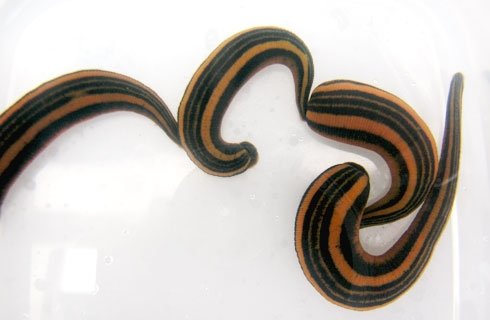
Leeches today.
Medicinal leeches have made a comeback in microsurgery all around the world. They provide an effective means to reduce blood coagulation, to relieve venous pressure from pooling blood or failure of venous drainage after surgery in reattachment and reconstruction operations. The therapeutic effect is not so much from the blood taken out by the leech, as this quantity is relatively small, but from the continued and steady bleeding from the small wound left by the leech after it has detached. This continued bleeding is the result of over 60 different anticoagulant compounds found in the saliva, which the leech secretes when it bites. Due to their saliva also having anaesthetic properties, leeches are well tolerated by patients, despite their potentially creepy reputation, and can be the difference between a good or a bad clinical outcome for a patient.
The species of leech most commonly used for this purpose worldwide is the European medicinal leech, Hirudo medicinalis, and Hirudo michaelseni. However, in New Zealand we use another species, Richardsonianus mauianus, which, though a little smaller, is very similar and equally as effective. R. mauianus is not an endangered species, they are found in many locations throughout New Zealand and we are breeding them successfully in captivity.
For more information see our UK friends: www.biopharm-leeches.com